
Most platforms give you a place to store candidates. They show you who applied, let you add notes, and maybe send an automated rejection email. But the actual work of evaluating people, deciding who moves forward, and keeping the process from stalling still falls entirely on your team.
Nodi is built differently. The evaluation layer is built in. The pipeline moves on its own. And when you need to find a specific type of candidate fast, you can just ask for them.
The goal is not to give your team more tools to manage. It is to give them a system that manages itself, so they can focus on the decisions that actually require human judgment.
The AI Agent: Search for Candidates Like You're Talking to a Person
One of the most powerful features in Nodi is the AI agent. Think of it like a ChatGPT that has access to over 900 million candidate profiles across LinkedIn, Nodi's own network, and other databases.
You type what you are looking for in plain language. Not a form, not a filter menu. Just a conversation.
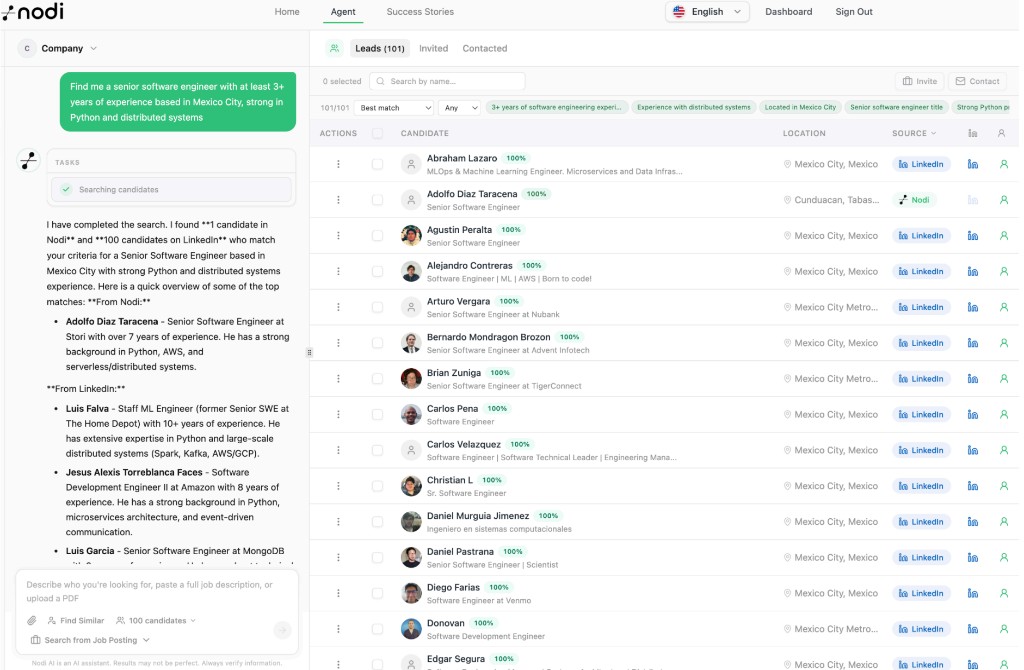
You: "Find me a senior software engineer with at least 3+ years of experience based in Mexico City, strong in Python and distributed systems."
Nodi: Here are 20 profiles that match. Ranked by fit.
The agent pulls candidates that match your description, ranks them, and surfaces their full profiles for you to review. You can refine the search, go deeper on specific requirements, or ask for something completely different. It works the way you think, not the way a search form forces you to think.
Rich Candidate Profiles
Every candidate in Nodi has a profile that goes well beyond a resume. When you open someone's profile you see the full picture.
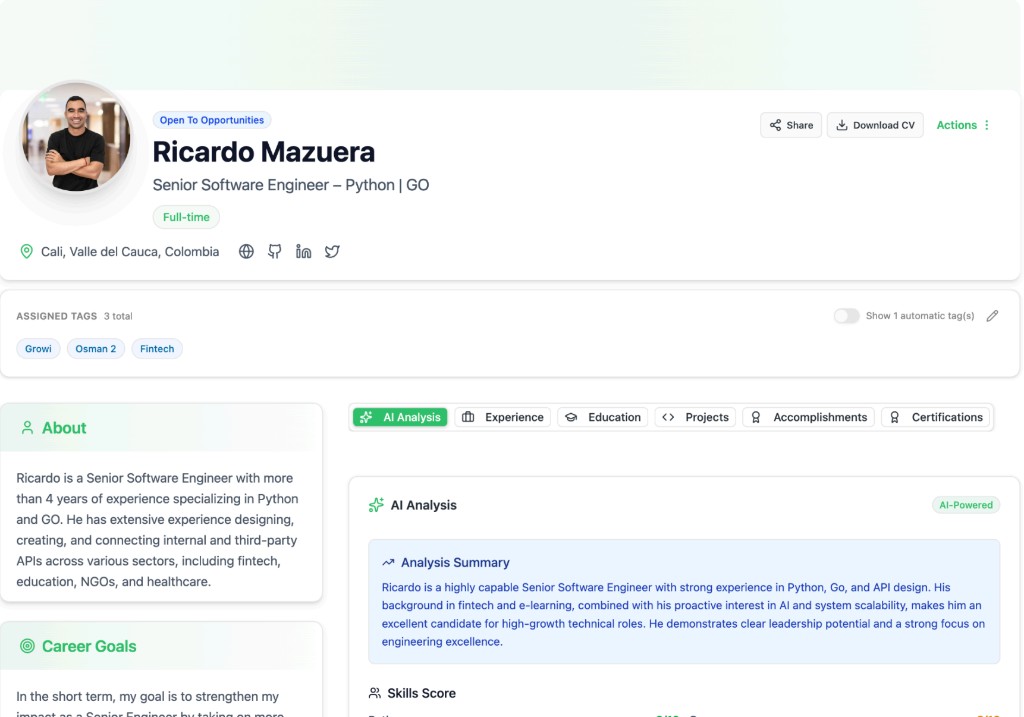
Contact and professional links
Email address, phone number, LinkedIn profile, and any other relevant links. Everything you need to reach out is in one place — no digging through attachments or emails.
Career goals and motivations
What the candidate is looking for in their next role, why they are open to new opportunities, and what kind of environment they thrive in. This context matters when you are deciding whether to move someone forward.
Salary expectations
Their compensation preferences are visible on the profile. No surprises at offer stage because you did not ask early enough.
Experience and skills summary
A structured breakdown of their background, what they have built, what they know, and where they have worked. More useful than a raw resume because it is formatted consistently across every candidate.
Assessment and interview results
If the candidate has completed any evaluations inside Nodi, those results live on the profile too. Technical scores, AI interview performance, psychometric profile. Everything in one view.
AI Interviews with Custom Evaluation Criteria
Nodi's AI interviews are not generic screening calls. You tell the AI exactly what to focus on for this role, and it evaluates every candidate against those specific criteria.
Before the interview runs, you define your priorities. Maybe you care most about how a candidate handles ambiguity, their approach to system design, and how clearly they communicate technical ideas. You set those as your criteria and weight them however you want.
The AI runs a structured interview with every candidate. Afterwards, you get a ranked breakdown of how each person performed across the criteria you defined. Not a generic score — a specific read on the things you told it to focus on.
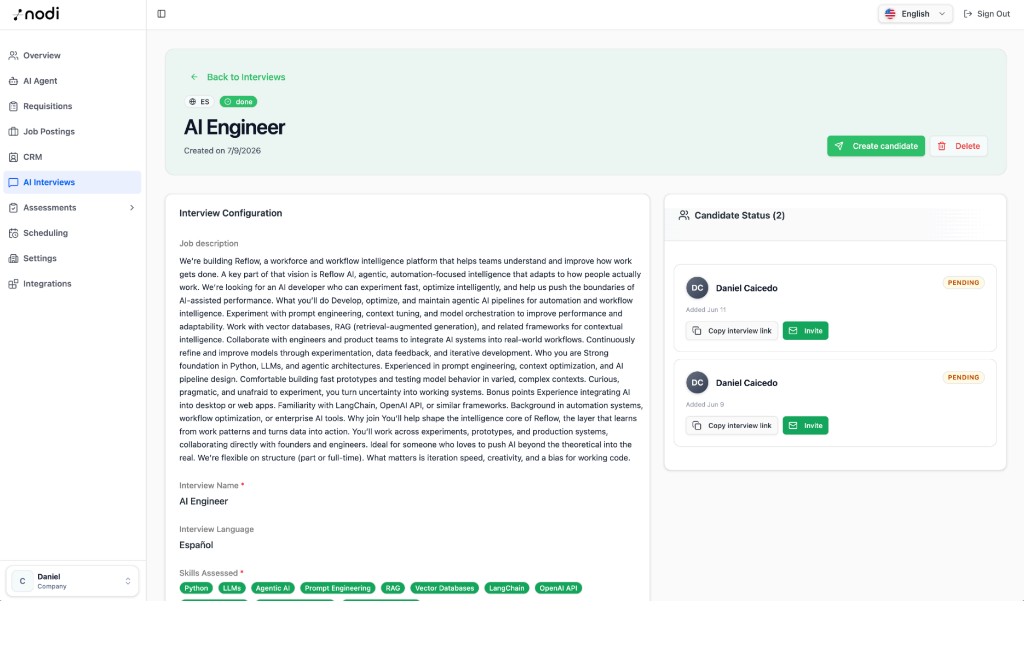
You are not just getting a pass or fail. You are getting a scored profile of each candidate across the exact dimensions you care about, so the comparison between candidates is actually useful.
A Pipeline You Build and Control
Every company runs their hiring process a little differently. Some do two rounds. Some do four. Some have a technical screen before a culture conversation. Nodi does not force you into a fixed structure.
You build your pipeline the way your process actually works. Define your stages, name them whatever makes sense for your team, and set the order. Once it is set up, candidates move through it and your team sees exactly where everyone stands at every moment.
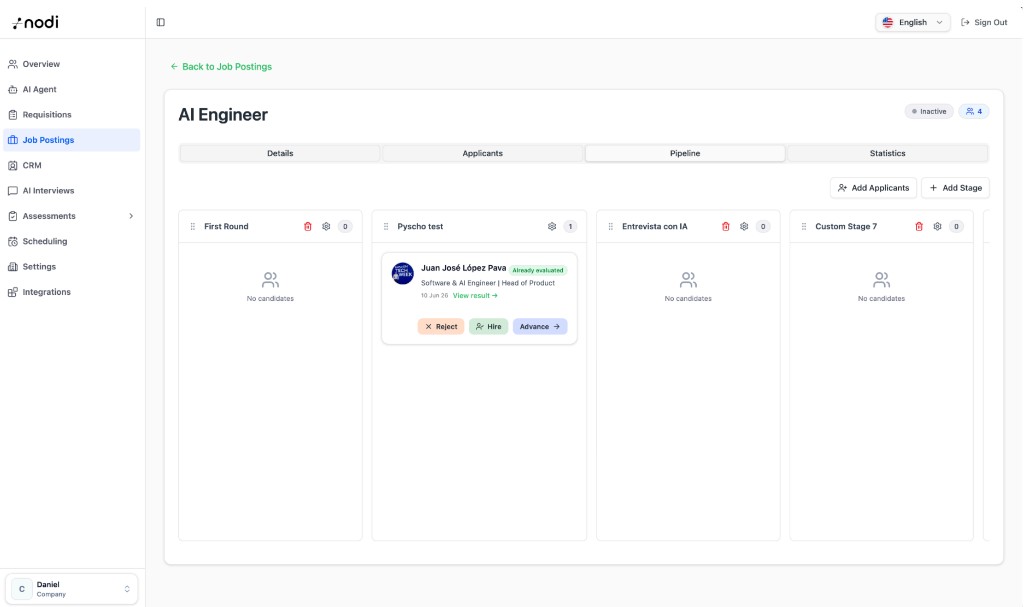
Moving candidates between rounds
When a candidate is ready to move forward, you advance them to the next stage in one click. If you want to automate that transition based on a score or a completed evaluation, you can do that too. The pipeline stays current and everyone who needs visibility has it.
Bulk and individual candidate communication
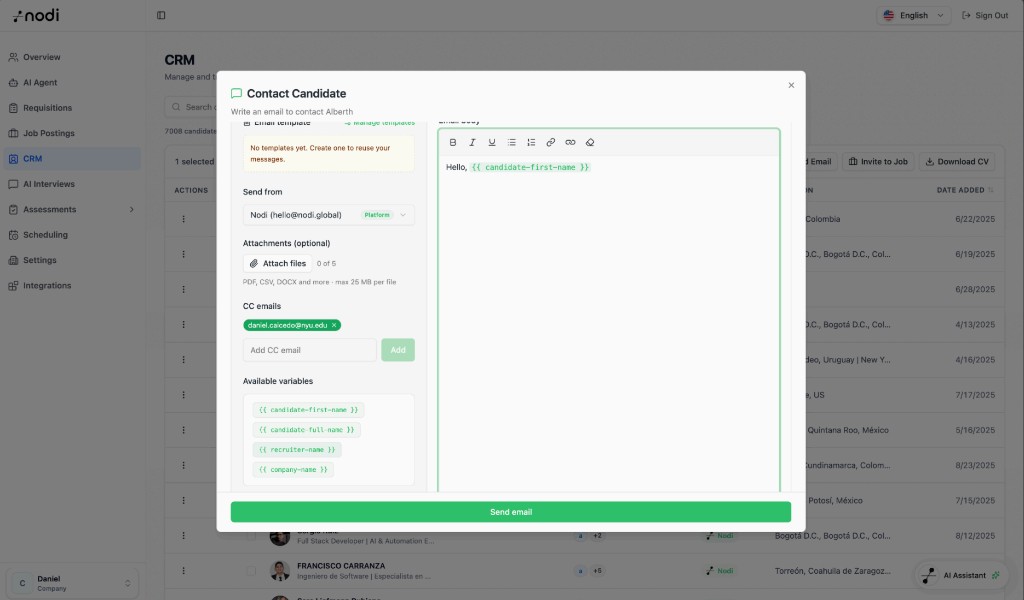
Once you know who you want to move forward, communicating with them should be fast. Nodi has pre-written email templates built into the platform for every common scenario: inviting someone to the next round, scheduling an AI screening, requesting an assessment, sending a rejection with care.
You can send to a single candidate or to a group at once. Select the ones you want, pick the template, personalize if you need to, and send. Every communication is logged on the candidate's profile so anyone on the team can see the full history.
Optional: assessments at any stage
Technical and psychometric assessments are available as optional tools you can add to any stage of your pipeline. If you want to send a coding challenge after the AI interview, you can. If you want a psychometric evaluation before the first human conversation, that works too.
They are not required. Some roles need them, some do not. When you do use them, the results land on the candidate's profile and factor into their overall ranking automatically.
The Impact in Numbers
900M+
profiles searchable through the AI agent
Custom
interview criteria so you evaluate what matters to you
14 days
average time to hire with Nodi
Clients like Globant, MoneyGram, Aldeamo, Finkargo, and Correcto use Nodi's evaluation and pipeline features to run structured, consistent hiring processes without building a large recruiting operation to support them.
Ready to hire smarter?
See Nodi in action
Schedule a demo and see exactly how Nodi works for your hiring situation — your stack, your team, your market.